CREDIT PULSE FOR VENDOR RISK MANAGEMENT

The risk layer your vendor risk management is missing.

Your TPRM program has a compliance track, a cyber track, and probably a questionnaire track. What it almost certainly does not have is a financial risk track.


That is the gap. UpGuard tells you whether a vendor can be hacked. A SIG questionnaire tells you whether they have an information security policy. Neither tells you whether that vendor will still be operating in 18 months. That question requires financial data, not compliance documentation.


Vendor financial risk is the probability that a supplier will be unable to fulfill its obligations because of financial distress, liquidity failure, or bankruptcy. It is the most operationally consequential category of vendor risk. It is also the one most procurement and vendor management programs are built to miss.


Why vendor financial risk gets ignored

Most third-party risk programs were designed by compliance and security teams. They ask questions like: does the vendor have a SOC 2? Have they completed a data processing agreement? Has their ISO certification expired? These are legitimate questions. They are also not the questions a supplier manager asks when a critical component stops arriving on time.


Platforms like OneTrust, Archer, ProcessUnity, and Venminder are built to answer the compliance and security questions. They track questionnaire completion rates, certification expiration dates, and control gaps. They are not built to tell you that your supplier's trade payables have stretched from 32 days to 78 days over the past two quarters, or that a lender just filed a UCC-1 against their primary manufacturing assets.


Cyber risk platforms like UpGuard, SecurityScorecard, BitSight, SAFE Security, and Panorays add another layer: they tell you whether a vendor's external attack surface is clean. That matters. It is also not a proxy for financial health.


A vendor can score green on every cyber rating platform and file Chapter 11 the following month. Envelope 1 Packaging did in 2024. So did Harvest Sherwood Food Distributors. The companies caught off guard were not running poor security checks. They were running no financial checks.


What vendor financial risk actually looks like


Financial distress rarely announces itself at once. It accumulates over 12 to 18 months in data that is available to anyone who looks for it.


Stretching payables. A supplier who was paying their own vendors in 32 days is now averaging 74 days. That is not a payment style preference. It is a cash squeeze. Trade payment data from commercial credit bureaus captures this signal 6 to 12 months before a bankruptcy filing. Most vendor management teams never see it because no one is pulling it.


New liens. A UCC-1 financing statement filed against a vendor's primary assets tells you that a lender now has a secured claim on what the vendor owns. A single secured lender is normal. Multiple stacked liens from different lenders filed within 18 months is a capital structure under pressure. If the vendor files for bankruptcy, you are an unsecured creditor recovering cents on the dollar behind every one of those secured lenders.


Revenue concentration. A supplier whose two largest customers account for 65% of revenue is a single bankruptcy notification away from a revenue collapse. This does not appear in any questionnaire. It requires either a conversation or a financial analysis.


Balance sheet deterioration. A current ratio below 1.0 means the vendor's short-term liabilities exceed their short-term assets. A debt-to-EBITDA above 5x for a distribution or manufacturing business means debt service is consuming a significant portion of operating cash flow. These numbers are in financial statements. Most vendors will not share them. The ones that will often do so because it is a condition of the contract.


Industry and news signals. A vendor's primary industry just absorbed significant tariff pressure. Their largest customer filed for bankruptcy three months ago. Their CFO resigned after eight months on the job. None of this is in a SIG questionnaire. All of it is findable in 20 minutes.


The signals that arrive before the filing


The Altman Z-Score was developed in the 1960s specifically to predict corporate bankruptcy from financial ratios. It is imperfect for modern businesses, particularly asset-light service companies. But the principle it formalized is still correct: financial distress telegraphs itself through measurable ratios before it becomes visible through behavior.


The signals that appear earliest, in roughly the order they tend to appear:


  1. Trade payment days outstanding begins extending
  2. Trade credit limits from other suppliers get reduced
  3. New secured debt appears (UCC filings, covenant amendments)
  4. Gross margin begins compressing quarter over quarter
  5. Working capital turns negative
  6. News coverage touches on financial difficulty, leadership changes, or customer losses
  7. Bankruptcy filing

By the time step 7 happens, steps 1 through 6 have been visible in data for months. The companies that got hurt by the Harvest Sherwood bankruptcy were companies whose vendor monitoring programs were looking at questionnaire return rates, not trade payment trends.


For a detailed walkthrough of how to identify these signals at the account level, see How to Assess a Supplier's Financial Health. For the specific early warning signs that precede a vendor bankruptcy filing, see Vendor Bankruptcy Risk: 7 Early Warning Signs Your Supplier Is in Trouble.


How to assess vendor financial health


Financial assessment for vendors follows the same logic as financial assessment for customers. The data sources are different, the decisioning is different, but the underlying question is the same: what is the probability this counterparty cannot meet their obligations?


Step 1: Pull trade payment data. D&B, Experian Business, and Equifax Business all publish trade payment performance data based on how vendors pay their own suppliers. Pull a score at onboarding. Set a calendar to check it quarterly for strategic suppliers, or set an alert to notify you when the score changes significantly.


Step 2: Run a lien search. Search the relevant secretary of state filings for UCC-1 financing statements. This takes 10 minutes and is free. You are looking at how many secured lenders exist and when the most recent ones filed. Recent stacked filings warrant a conversation.


Step 3: Check federal court records. PACER gives you access to bankruptcy case filings and significant litigation. A prior Chapter 11 with surviving debt obligations is not disqualifying, but it is context that matters when you are making a sole-source decision.


Step 4: Assess ownership and structure. Is this a subsidiary of a foreign parent? A private equity portfolio company with an LBO capital structure from 2021? A family business where the founder owns 100% with no succession plan? Each structure carries a different risk profile.


Step 5: Ask about customer concentration for strategic suppliers. Any vendor that represents more than 5% of your procurement spend is a strategic supplier. Knowing that their top two customers account for 70% of their revenue is essential context for that relationship.


Step 6: Request financial statements. Many private vendors will decline. Request them anyway for critical suppliers, and consider making disclosure a contract condition for new strategic agreements. If they provide them, look at current ratio, EBITDA margin trend, and debt service coverage.


For a complete guide to running this assessment from scratch, see How to Assess a Supplier's Financial Health. For a structured checklist version of this process, see the Vendor Financial Due Diligence Checklist.


Why annual reviews are not a vendor financial risk program


Procurement teams with formal vendor review cycles typically run them once a year, sometimes twice. The review confirms that the vendor is still active, that key certifications have not expired, and that the relationship is still meeting performance KPIs.


This cycle has nothing to do with financial risk. A vendor who passed your annual review in January can file for bankruptcy in April. The review told you where things stood on a single day. It told you nothing about the direction of travel.


Financial risk requires continuous monitoring, not calendar reviews. The signals that matter — trade payment trends, lien filings, news — update continuously. A monitoring program that checks them once a year is not a monitoring program. It is documentation.


This is not a criticism of the teams running annual reviews. It is a description of what the existing tooling makes possible. If your vendor risk platform is a questionnaire system with an annual reminder, continuous financial monitoring is not something it was designed to do. The workflow does not exist in the tool.


For a detailed look at how to build a continuous monitoring program that actually works, see Continuous Vendor Monitoring: Why Annual Reviews Miss the Risks That Matter.


Vendor financial risk vs. supplier credit risk


The two terms describe the same problem from different organizational vantage points.


Supplier credit risk is the language of procurement and supply chain teams: the risk that a supplier cannot fulfill a purchase order because they are in financial distress. Vendor financial risk is the language of vendor management and TPRM teams: the financial layer of third-party risk that cyber and compliance programs do not cover.


Same signals. Same data. Same consequence when ignored. The difference is who in the organization is responsible for managing it and what their existing tools look like.


Credit Pulse sits at the intersection. The platform was built to surface financial risk signals on counterparties — originally for credit teams assessing customers, now equally for procurement and vendor management teams assessing suppliers. The data sources are the same. The monitoring logic is the same. The output is a continuous financial health signal rather than a point-in-time questionnaire score.


For the supply chain and procurement angle, see Supplier Credit Risk: A Practical Guide for Vendor Managers.


Where Credit Pulse fits into a vendor financial risk program


RapidRatings is the only legacy platform that sits specifically in the vendor financial risk lane. It is a reporting tool. An analyst pulls a report, reads a score, and writes a memo. The data is updated periodically. The workflow runs manually. The cost reflects analyst hours, not automation.


Credit Pulse does the same job continuously and in the background. At onboarding, the platform runs a financial health assessment on the vendor: trade payment data, lien search, news signals, ownership structure. For strategic suppliers, the assessment includes a financial statement analysis if data is available.


After onboarding, the platform monitors continuously. When a financial signal changes, it flags the relevant vendor for review rather than waiting for the next calendar cycle. The credit team or procurement team reviews the flag and decides what to do. The platform handles the data aggregation and the alerting. The judgment call stays with the team.


The practical outcome: a vendor manager monitoring 300 suppliers can run a real financial risk program without an analyst team dedicated to pulling bureau reports and reading trade data. The work that took three analyst-hours per vendor per quarter happens automatically.


The financial risk layer in a complete TPRM program


A complete third-party risk program covers five categories of risk: cyber risk, compliance and regulatory risk, geographic and political risk, operational risk (capacity, quality, continuity), and financial risk. Most enterprise TPRM programs have the first two covered well and the last three covered poorly.


Financial risk is the most directly operational of the five. A vendor with a cyber incident can often continue operating while they remediate. A vendor that files for Chapter 11 stops shipping.


The goal is not to add a sixth questionnaire to your vendor onboarding process. It is to run the financial assessment using data rather than self-disclosure, and to monitor that data continuously rather than reviewing it annually. That is what makes vendor financial risk management a program rather than a checkbox.


See what Credit Pulse surfaces on your key suppliers


Pull a vendor financial health assessment on any supplier in minutes. Trade payment performance, lien history, news signals, ownership structure. No analyst hours required.

Try it free or book a walkthrough.


Related reads

Thank you! Your submission has been received!
Oops! Something went wrong while submitting the form.

Trusted by:

THE BLIND SPOT IN YOUR TPRM

Most TPRM tools were built for cyber and compliance. They run questionnaires, check SOC 2 reports, and score attack surface. None of that tells you whether your supplier is six months from Chapter 11. When a critical vendor goes under, the damage isn't theoretical — it's missed shipments, failed audits, and an emergency rebid.

STALE QUESTIONNAIRES

Annual questionnaires go stale the day you send them.

CYBER RATINGS MISS FINANCIAL DISTRESS

Cyber ratings don't cover financial distress.

SPREADSHEETS DON'T SCALE

SPREADSHEETS DON'T SCALE

THE SOLUTION

Continuous vendor financial risk, on autopilot.

Minutes

Time to first vendor score

100%

Continuous monitoring coverage

15

day target DSO for top tech performers
White six-pointed starburst shape on a black background.White six-pointed starburst shape on a black background.
ACME Corporation credit application form titled Credit Application, showing company details section with fields filled: Company Name Ironclad Supply, Website www.ironcladsupply.com, Address 123 Main Street, Business Type Corporation.
THREE STEPS. NO PROCUREMENT OVERHAUL.

Step 1: Connect your vendor list

Upload a CSV or sync from your ERP. We handle entity matching automatically.

LEARN MORE
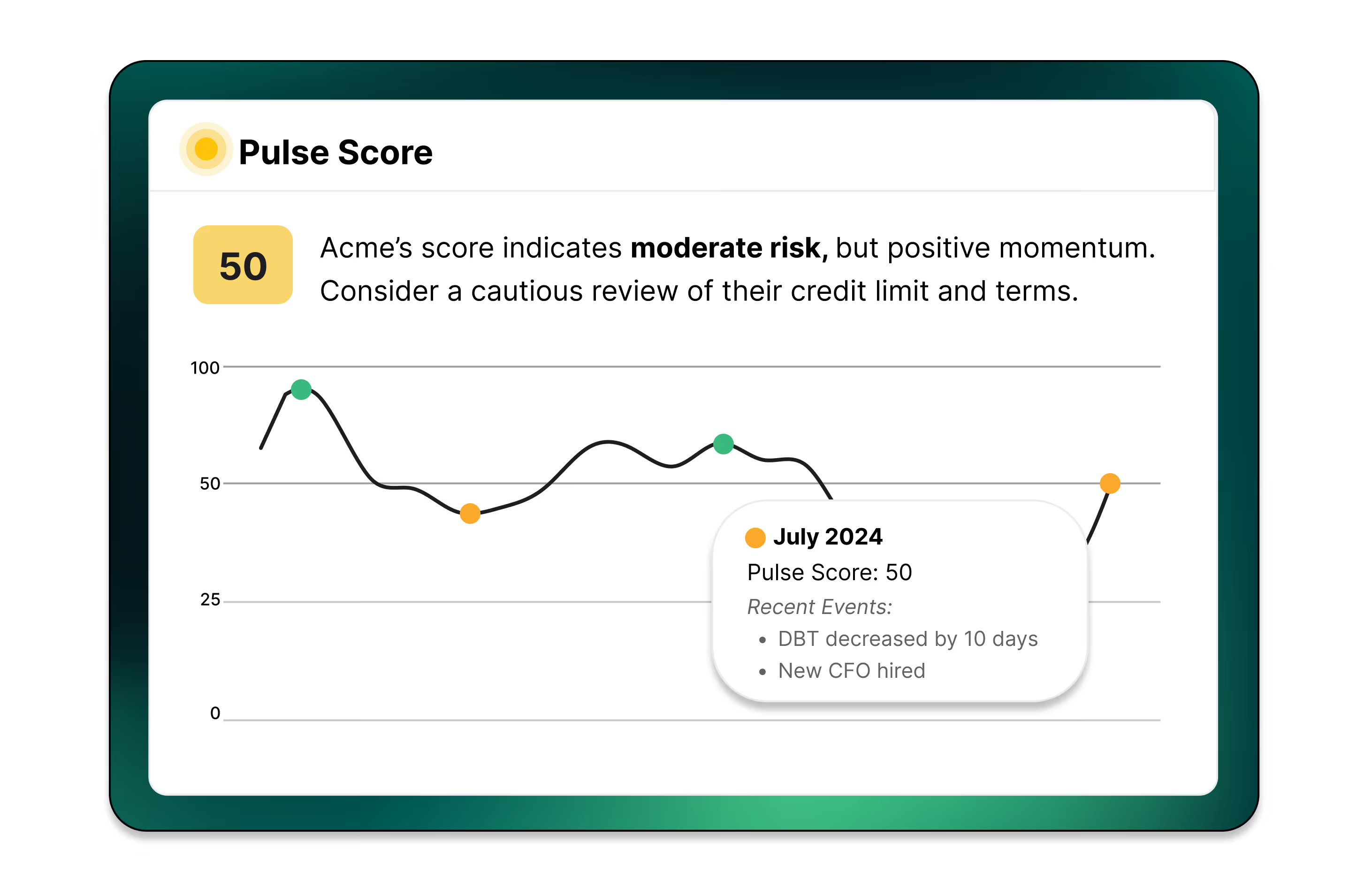
Pulse Score chart showing a score of 50 indicating moderate risk with positive momentum for Acme, including recent events such as DBT decreased by 10 days and new CFO hired in July 2024.
THREE STEPS. NO PROCUREMENT OVERHAUL.

Step 2: We score every vendor

Our research agents pull financial signals, credit data, and public filings. You get a score and a written risk summary per vendor in minutes, not weeks.

LEARN MORE
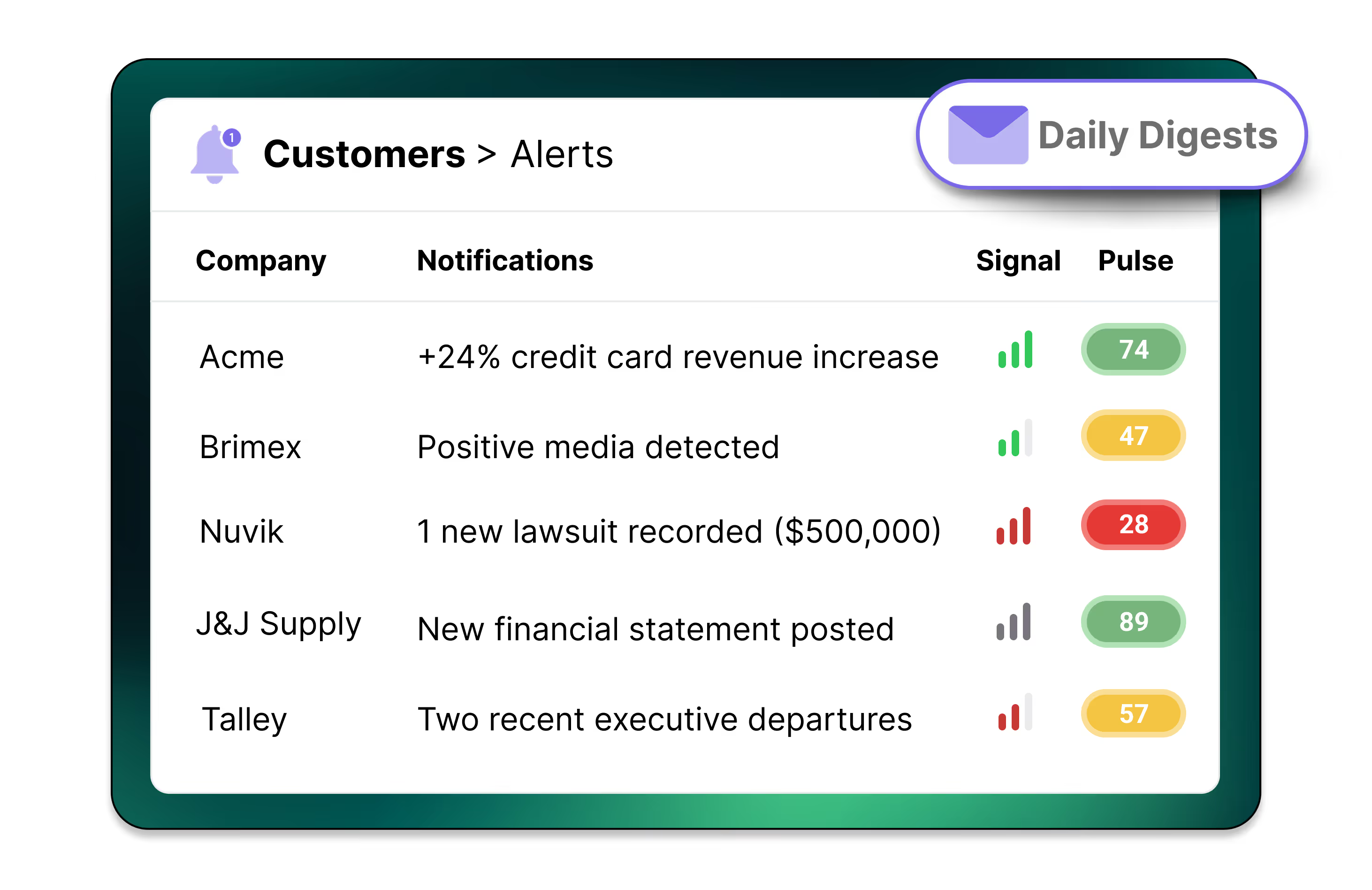
Table of customer alerts showing company names, notifications, signal strength with colored bars, and pulse scores in colored ovals, with a Daily Digests email icon.
THREE STEPS. NO PROCUREMENT OVERHAUL.

Step 3: We monitor every vendor

Don't guess with vendors. Credit Pulse monitors your entire portfolio for emerging supply chain risk.

LEARN MORE
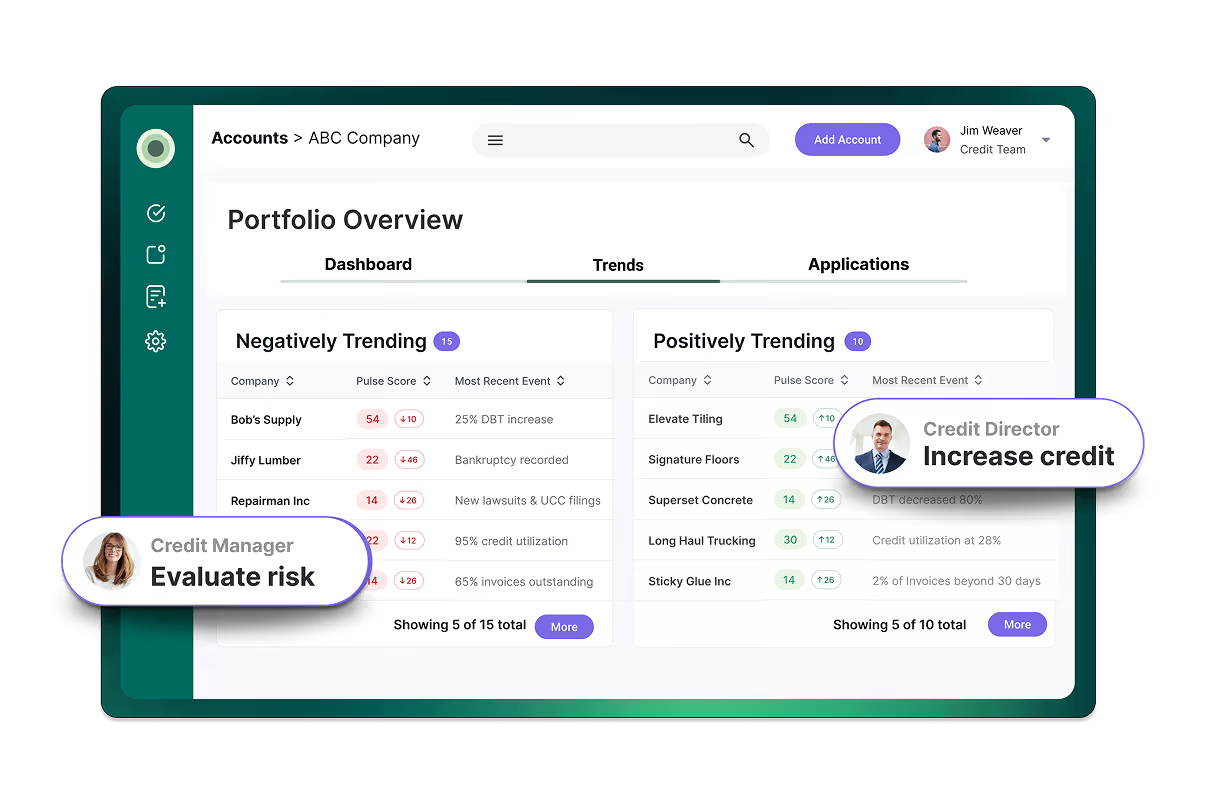
Dashboard interface showing portfolio overview with negatively trending companies on the left and positively trending companies on the right, including pulse scores and recent events, with prompts for Credit Manager to evaluate risk and Credit Director to increase credit.
THREE STEPS. NO PROCUREMENT OVERHAUL.

Three Steps.
No overhaul.

GET STARTED

Ready to modernize credit for your SaaS business?

MANUFACTURING

Nathan Rugg

Chief Financial Officer

Matrix needed to standardize credit policies across all of its operating companies. Manual processes and monitoring gaps slowed decision-making while increasing risk. With Credit Pulse, they were able to:

  • Integrate companies into one system for approvals & monitoring
  • Monitor key customer changes with signal-based alerts
  • Reduce turnaround time in credit requests to speed up orders
BUILDING MATERIAL

Nicholas Scatuorchio

President & CEO

Same-Day Metal needed to speed up credit approvals and improve risk monitoring. Manual checks slowed decisions, delayed orders, and added uncertainty. With Credit Pulse, they were able to:

  • Accelerate orders with faster application approvals.
  • Extend credit confidently with data-driven recommendations.
  • Stay ahead of risk with real-time alerts across their portfolio.
FOOD & BEVERAGE

James Kim

VP of Finance

As product demand surged, Nowadays' credit process required an upgrade. Manual applications and limited credit insights hindered the efficiency of their thriving business. With Credit Pulse, they were able to:

  • Streamline onboarding with a digital credit application
  • Access deeper creditworthiness insights for small retailers
  • Make informed decisions & monitor key changes to mitigate risk

    Transform your credit process today.

    Meet with our team or try us free for 30 days.

    Book a Demo
    White six-pointed starburst shape on a black background.White six-pointed starburst shape on a black background.